There is one honest answer and one useful answer. The honest one: nobody can size a solar system from square footage or from a monthly bill alone. The useful one: you can get within about 10% using your annual kWh, the sun hours where you live, and one formula. Here is that formula, with the numbers already worked out for you.
| Your situation | System size | 500W panels | Roof needed |
|---|---|---|---|
| Apartment or small home, bill under $100 | 3–5kW | 6–10 | 180–300 sq ft |
| Average US home, bill $100–$160 | 7–8kW | 14–16 | 420–480 sq ft |
| Large home, bill $160–$250 | 10–12kW | 20–24 | 600–720 sq ft |
| All-electric, pool or two EVs | 15–20kW | 30–40 | 900–1,200 sq ft |
The formula, and why it works
System size in kilowatts is your annual consumption divided by how much one kilowatt produces where you live:
System size (kW) = annual kWh ÷ annual kWh per installed kW
A kilowatt of panels in Austin makes about 1,450 kWh a year. The same kilowatt in Seattle makes about 1,090 kWh, because Seattle gets fewer peak sun hours and more cloud. This is why "what size system do I need" has no national answer — it has a national average and a local correct value.
That 1,450 figure already includes real-world losses: inverter conversion, wiring, soiling, and the fact that panels get hot and lose a little output. It is not the nameplate rating multiplied by 24 hours, which is the mistake behind most inflated promises you will see online.
Step 1: turn your bill into annual kWh
Find the kWh line, not the dollar amount. Take twelve months if you can — a summer-only sample in Texas will oversize the array for the year. Then add them up. If your utility only shows a monthly average, multiply by 12.
If you only know the dollar amount, divide by your rate. At $0.17/kWh, a $170 bill is 1,000 kWh. At $0.30/kWh — California, parts of New England — the same bill is 570 kWh, and the system that covers it is much smaller. This is the single most common sizing error we see from homeowners comparing quotes online.
| Monthly bill | Monthly kWh | System size | Panels | Roof area |
|---|---|---|---|---|
| $80 | 470 | 4kW | 8 | ≈240 sq ft |
| $120 | 700 | 6kW | 12 | ≈360 sq ft |
| $160 | 940 | 8kW | 16 | ≈480 sq ft |
| $200 | 1,175 | 10kW | 20 | ≈600 sq ft |
| $250 | 1,470 | 12kW | 24 | ≈720 sq ft |
| $350 | 2,060 | 18kW | 36 | ≈1,080 sq ft |
Step 2: use your state's sun hours, not the national average
Annual production per installed kilowatt, after losses, for representative US locations. Multiply your system size by these to sanity-check any quote you are given.
| Location | kWh per kW per year | 7kW system produces | 10kW system produces |
|---|---|---|---|
| Seattle, WA | 1,090 | 7,630 kWh | 10,900 kWh |
| Boston, MA | 1,200 | 8,400 kWh | 12,000 kWh |
| Chicago, IL | 1,240 | 8,680 kWh | 12,400 kWh |
| New York, NY | 1,230 | 8,610 kWh | 12,300 kWh |
| Atlanta, GA | 1,410 | 9,870 kWh | 14,100 kWh |
| Austin, TX | 1,450 | 10,150 kWh | 14,500 kWh |
| Denver, CO | 1,500 | 10,500 kWh | 15,000 kWh |
| Los Angeles, CA | 1,560 | 10,920 kWh | 15,600 kWh |
| Phoenix, AZ | 1,700 | 11,900 kWh | 17,000 kWh |
The spread is the point. A 10kW array in Phoenix produces 56% more than the same array in Seattle. If a salesperson quotes you the same annual saving in both places, they are guessing.
Step 3: the five things that change the answer
- An EV. The average American drives about 13,500 miles a year. At 3.5 miles per kWh that is roughly 3,850 kWh — about 2.7kW of extra array. Add it before you size, not after.
- Electric heat or a heat pump. A cold-climate heat pump can add 4,000–8,000 kWh a year compared with gas heating. This is the biggest single jump most homes make.
- A pool. A 1.5HP pump running six hours a day adds roughly 2,500 kWh a year.
- Shade. An afternoon-shaded roof can lose 15–25%. Microinverters or DC optimisers recover some of it; nothing recovers all of it. See panel and inverter types.
- Roof direction. A due-west array makes about 10–15% less annually than due-south but produces more at 5pm, which can be worth more under time-of-use rates.
Step 4: check the roof can take it
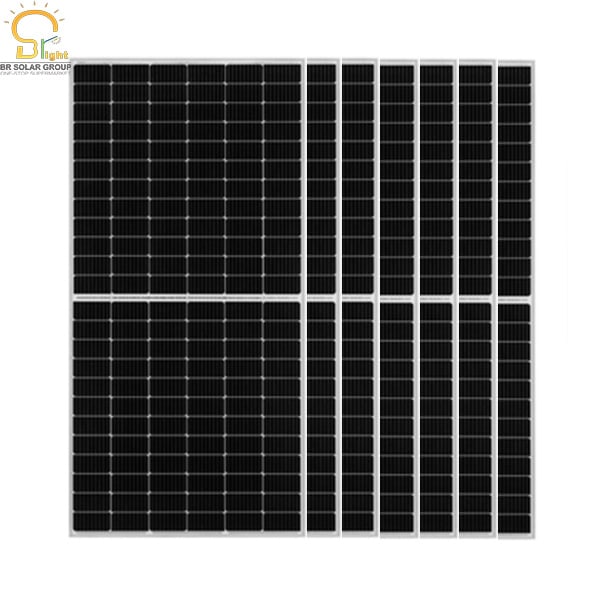
A 500W panel is roughly 6.5 × 3.5 ft, about 23 sq ft. Plan on 30 sq ft of usable roof per panel once you allow for walkways, fire setbacks and obstructions. A 8kW system with 16 panels needs about 480 sq ft of unshaded plane — a 22 × 22 ft rectangle.
If the roof is smaller than the array you need, the options in order of cost are: higher-wattage panels (600W modules fit 20% more capacity in the same area), a ground mount, or a smaller system with a battery to shift the evening load. Our panel-count guide has the roof maths in more detail.
If you are sizing off-grid, ignore everything above
Grid-tied sizing is an annual average problem. Off-grid sizing is a worst-day problem. You size for the shortest, cloudiest stretch of December, then add 30–50% margin, and you size the battery for the longest night — not for a daily average.
A full-time off-grid home that averages 30kWh a day typically lands on a 15–20kW array and 30kWh or more of usable storage, plus a generator for the two or three weeks a year the maths does not work. Our smallest true off-grid package is the 10kW off-grid kit with 13.5kWh of Pylontech storage, which suits a well-insulated home with modest loads and a backup generator. See grid-tied, hybrid or off-grid for how the three architectures differ.
Step 5: does a battery change the array size?
It can. Without storage you size the array to your total consumption and accept that evening power comes from the grid. With storage, you size the array to what you can usefully store plus what you use in daylight — which sometimes means a slightly larger array, because you are now charging a battery as well as running the house.
Battery capacity is measured separately, in kWh, and is not part of your kW figure. A "10kW system with 13.5kWh battery" is 10kW of panels and 13.5kWh of usable storage; the two numbers are not convertible. Our savings calculator shows both.
Which of our kits matches which size
Every kit is built around one of the sizes above, so you can go from this guide straight to a price. The comparison table puts them side by side.
- 3kW — 3kW Starter, for condos, apartments and small homes under 500 kWh a month.
- 5kW — 5kW Basic Home, the average two-bedroom household.
- 7kW — 7kW Standard Home, a home with central air and a water heater.
- 8kW — 8kW Complete Home, the national-average home, battery-ready.
- 10kW — 10kW Premium Home, or the 10kW off-grid for a property with no utility connection.
- 12kW — 12kW Whole Home, for a large house with a pool or two EVs.
- 15kW and 20kW — 15kW Luxury and 20kW Commercial, for large homes, farms and small business.
If your number falls between two kits, take the smaller one and put the difference into a battery, or take the larger one if you expect to add an EV in the next three years. Both are defensible; guessing a size you cannot fill with panels is not.
Three mistakes worth avoiding
- Sizing to a dollar target rather than a kWh target. "I want to spend $15,000" produces a system that may cover 40% or 100% of your bill depending on your state. Start with kWh.
- Oversizing for export. Export credits are now well below retail in most of the country. A system sized 130% of consumption usually earns less than one sized 100% with a battery shaving the evening peak. Read net metering versus net billing before you decide.
- Forgetting the federal credit is gone. The residential Section 25D credit ended for systems placed in service after December 31, 2025. Any quote that still subtracts 30% is out of date. State and utility programmes are the only remaining incentives, and they vary by address — see financing and incentives.
Questions we get about this
A typical US household uses about 10,500 kWh a year and needs a 7–8kW system: roughly 16 panels at 500W. That is the national average, not a recommendation — a home in Phoenix needs less capacity for the same kWh than the same home in Seattle.
Usually, unless you heat with electricity, run a pool pump, or charge an EV. A 10kW array will cover the load, but the extra output may be exported for a low or zero credit, which pushes payback out. Size to consumption first and treat export as a bonus.
It is a starting point, not an answer. Floor area predicts usage loosely; the bill is the real number. Two identical houses can use 6,000 and 18,000 kWh a year depending on insulation, appliances and how the occupants heat and cool.
Panels first, then the inverter around them. In the US it is normal and efficient to pair an 8kW array with a 7.6kW inverter — a DC-to-AC ratio up to about 1.3 is standard practice and clips only a few hours a year.
Size for your worst winter month, not the annual average, and add 30–50%. An off-grid home that averages 30kWh a day may need a 15–20kW array and 30kWh of battery to get through December. Our 10kW off-grid kit is the smallest we would put on a full-time home, and only with a generator backup.
Want the numbers for your house?
Send three months of electric bills and a roof photo. A designer confirms the array size, the kit and the delivered price — usually within two business hours.
Get a free system review