Kit pricing is easy to publish and hard to compare, because every seller draws the line in a different place. Here is our full price list, what is inside each price, what is not, and how to compare a kit against a turnkey quote without being fooled by either.
Every kit, with cost per watt
| Kit | Size | Type | Price | $/watt |
|---|---|---|---|---|
| 3kW Starter | 3kW | Grid-tied | $8,999 | $3.00 |
| 5kW Basic Home | 5kW | Grid-tied | $12,499 | $2.50 |
| 7kW Standard Home | 7kW | Grid-tied | $15,999 | $2.29 |
| 8kW Complete Home | 8kW | Hybrid | $18,499 | $2.31 |
| 10kW Premium Home | 10kW | Hybrid | $23,999 | $2.40 |
| 10kW Off-Grid | 10kW | Off-grid + 13.5kWh | $29,999 | $3.00 |
| 12kW Whole Home | 12kW | Hybrid | $26,999 | $2.25 |
| 15kW Luxury | 15kW | Hybrid + 27kWh | $38,999 | $2.60 |
| 20kW Commercial | 20kW | Hybrid | $54,999 | $2.75 |
Two patterns are worth noticing. Cost per watt falls as size rises — up to a point — because the inverter, disconnects, wiring and permit pack are roughly fixed costs. And the battery kits look expensive per watt until you remember the battery is most of the price: 27kWh of LFP storage is a five-figure component on its own.
What is inside the price
A complete kit is not a pallet of panels. For the 8kW hybrid, the $18,499 covers:
- 16 × Jinko Tiger Neo 500W panels (8,000W DC)
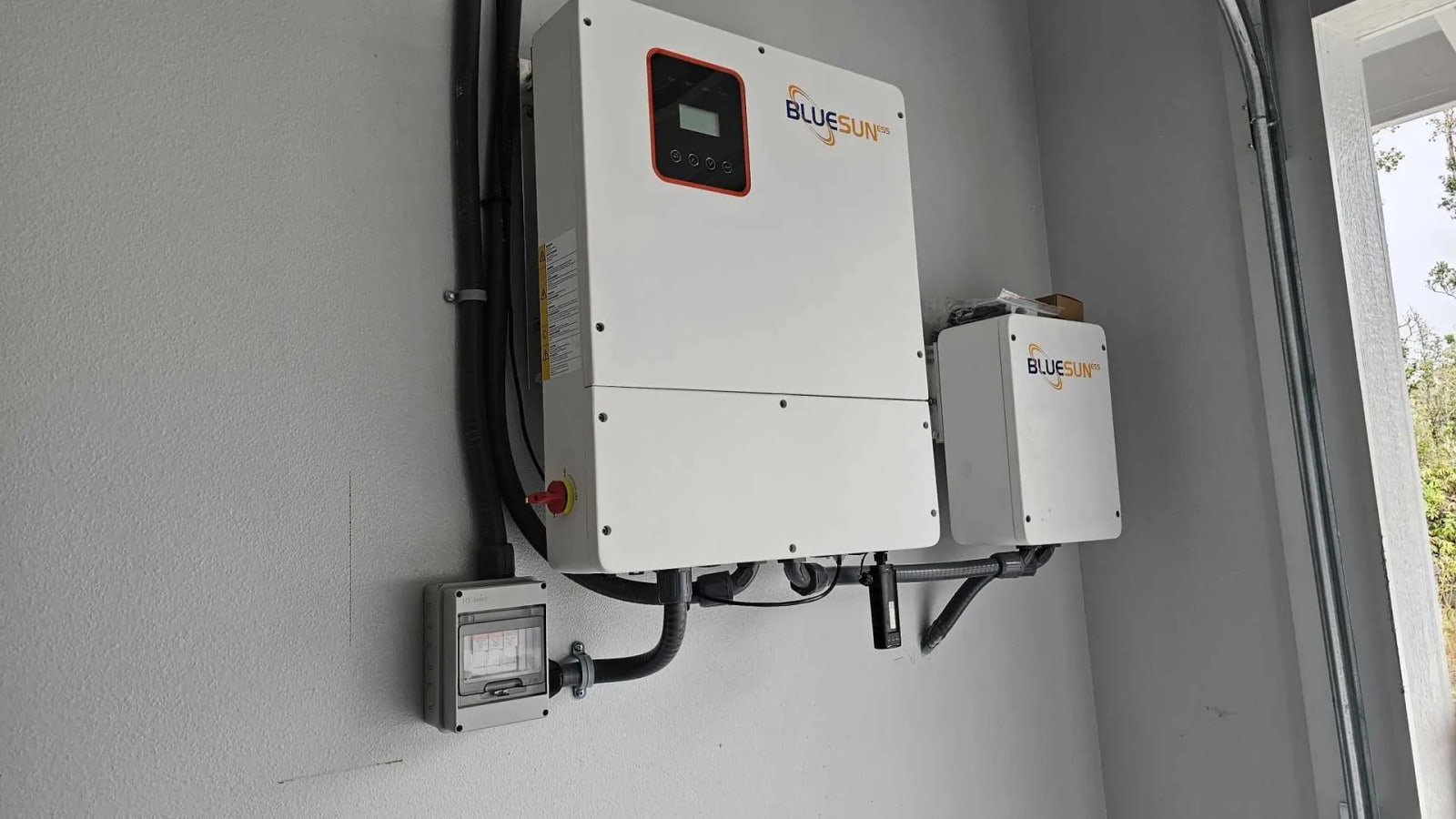
- Sunsynk 8kW hybrid inverter with battery terminals
- Unirac SRP4 roof rails, clamps and flashing
- Stäubli MC4 connectors and DC wiring
- Square D DC and AC disconnects
- Wi-Fi monitoring with export tracking
- Installation guide and permit/interconnection document pack
What is not in that number: freight to your address, sales tax, permit fees, the utility's interconnection fee, labour, main-panel upgrades, and the battery. Those are discussed below. Our shipping page explains how freight is quoted.
What each component actually costs
| Component | Typical price | Share of an 8kW kit |
|---|---|---|
| Panels (500W, N-type) | $0.35–$0.55/watt | ~40% |
| Hybrid inverter | $1,800–$3,500 | ~14% |
| Racking and flashing | $0.15–$0.25/watt | ~9% |
| Wiring, connectors, disconnects | $600–$1,200 | ~5% |
| Monitoring | $150–$500 | ~2% |
| Battery (5kWh LFP), optional | $2,499 | not included |
The biggest variable is panel price, which moves with tariffs and freight more than with technology. The second biggest is the inverter, where hybrid units cost meaningfully more than grid-tied string inverters — that premium is what buys you battery readiness. Our component shop publishes individual prices if you would rather build up than buy a package.
The five costs outside the kit price
- Freight. A full pallet of panels and racking ships by LTL freight, typically $300–$900 depending on distance and whether you need a liftgate. Panel-only orders can go by courier for less.
- Sales tax. Most states tax equipment. Several exempt solar equipment or offer a rebate; Texas and a handful of others do not.
- Permits and interconnection. $150–$800 for a residential building permit, plus whatever your utility charges to review the interconnection application.
- Labour. A licensed electrician for the AC side and a crew for the roof. $4,000–$10,000 for a typical residential array in 2026.
- Panel upgrade or remediation. If your main service panel is 100A or full, budget $2,000–$3,500. Old roofs are the other hidden cost — never install on a roof that needs replacing within five years.
Kit versus turnkey: how to compare honestly
| Route | Cost per watt | Who handles permits | Who handles warranty claims |
|---|---|---|---|
| Kit, self-installed | $2.30 + labour | You | You, with manufacturer |
| Kit plus your own installer | $2.30 + $0.50–$1.20 | Usually the installer | Split — equipment yours, workmanship theirs |
| Full turnkey installer | $2.50–$3.50 | Installer | Installer, single point |
Turnkey pricing is not automatically bad value. You are buying project management, a single warranty contact, and someone else's liability if the roof leaks. What you should not accept is a turnkey quote that hides a 40% margin behind an equipment list you cannot check. Ask for the panel model, the inverter model, and the per-watt price. If they will not give all three, walk.
Equally, do not assume a kit is cheap just because the number is smaller. Add freight, labour and permits before you compare. The installation guide walks through what a self-managed install actually involves, and our cost guide covers installed pricing line by line.
What incentives still exist in 2026
The federal residential credit is gone. Section 25D ended for systems placed in service after December 31, 2025, and there is no replacement for owner-occupied homes. What remains:
- State income-tax credits in a minority of states, usually capped.
- Property-tax exemptions in most states — the array does not raise your assessment.
- Sales-tax exemptions in about half the states.
- Utility rebates, most commonly for batteries rather than panels.
- Section 48E for business and commercial installations, with its own deadlines.
Because these are address-specific, we will not quote a net price before checking your ZIP. Financing and incentives has the current position, including what changed and when.
A payback worked example
An 8kW hybrid kit at $18,499, installed by your own electrician for $6,000, plus $700 freight and $500 in permits, lands at about $25,700 before any local incentive. In Austin at 1,450 kWh per kW per year it produces about 11,600 kWh; at $0.17/kWh that is roughly $1,970 a year if all of it offsets retail power. Simple payback is around 13 years.
That number is longer than the five-year paybacks you see advertised, because those quotes assume a 30% federal credit that no longer exists. Thirteen years on a system with a 25-year panel warranty is still a positive return — but it is an honest one, and it improves materially if you have a high local rate, a good net-metering tariff, or a battery that lets you avoid time-of-use peaks.
Run your own numbers with the savings calculator. It uses your rate and state sun hours and shows the payback range rather than a single flattering figure.
Which kit is the best value
By cost per watt, the 12kW Whole Home at $2.25/watt and the 7kW Standard at $2.29/watt are the strongest equipment values in the range. The 8kW Complete is $2.31 and adds battery readiness, which is why it is the most common choice.
The 3kW kit looks expensive per watt because the fixed components are spread over fewer panels. It exists for apartments and small loads, not for value. If you have the roof for 5kW and the usage to justify it, the 5kW is the cheaper system overall.
Use the comparison table to see every kit against every spec, and the sizing guide to work out which size you actually need before you look at price.
Questions we get about this
Our residential kits run from $8,999 for a 3kW grid-tied system to $38,999 for a 15kW hybrid with 27kWh of battery. The 8kW hybrid most families buy is $18,499. Freight, permits, sales tax and installation labour are separate and are itemized before you approve an invoice.
It should be, because you are buying equipment only and arranging the labour yourself. Turnkey residential solar runs about $2.50–$3.50 per watt installed in 2026; a kit is the equipment portion of that. Compare cost per watt, and ask what each price excludes, rather than comparing headline totals.
Freight, sales tax, permit fees, utility interconnection fees, installation labour, any roof or electrical remediation, and batteries unless the kit name says otherwise. Those are the five lines that turn a kit price into a project cost.
No. The residential credit under Section 25D ended for systems placed in service after December 31, 2025. Some state and utility incentives remain, and business installations may still qualify under Section 48E with its own deadlines. Anyone quoting you 30% off a 2026 residential system is out of date.
For a straightforward residential array, a licensed electrician plus a roofing crew typically adds $4,000–$10,000 depending on region, roof complexity and whether the main panel needs upgrading. A panel upgrade alone can be $2,000–$3,500.
Want the numbers for your house?
Send three months of electric bills and a roof photo. A designer confirms the array size, the kit and the delivered price — usually within two business hours.
Get a free system review