the byline, dates and any bracketed figures in this guide are sample values.
The three types at a glance
US solar companies generally sell three system types: grid-tied, hybrid and off-grid. All three can use the same panels and racking. The difference is the inverter, the battery, and whether the property has a utility service.
| System type | Utility connection | Battery | Backup power | Best for |
|---|---|---|---|---|
| Grid-tied without batteries | Required: interconnection agreement and permission to operate (PTO) | None | No — the inverter shuts down during an outage | Lowest equipment cost; best where the utility has strong net metering |
| Hybrid with or without batteries | Required: interconnection agreement and PTO | Optional; battery-ready inverter | Yes — essential circuits, if a battery and backup panel are installed | Bill savings plus outage backup; storage can be added later |
| Off-grid with batteries | None — no utility service | Required battery bank | Yes, within the battery and inverter limits | Remote properties where a utility connection is unavailable or too expensive |
The names are not marketing inventions. Utilities, inspectors and equipment datasheets use the same categories, although you will also see grid-connected, utility-interactive, grid-tied with storage and standalone.
Grid-tied solar system (without batteries)
A grid-tied system runs alongside your utility service. The inverter converts panel DC power to AC, feeds your electrical panel, and sends any surplus through the utility meter. There is no battery.
Because the inverter must not energize the grid during an outage, it shuts off when utility power is lost. That is called anti-islanding, and it is required for lineworker safety. A grid-tied system will not keep the lights on in a blackout, even on a sunny day.
- Lowest equipment cost and the shortest payback of the three types.
- Every exported kilowatt-hour is handled under your utility’s net-metering or net-billing tariff.
- No battery maintenance and no replacement cost in year 10–15.
- No backup power. If resilience matters, this is the wrong choice.
US naming: also called grid-connected or utility-interactive. The utility approval is an interconnection agreement, and the final approval to energize is permission to operate (PTO).
Our grid-tied kits: 3kW Starter, 5kW Basic, 7kW Standard and 20kW Commercial.
Hybrid solar system (with or without batteries)
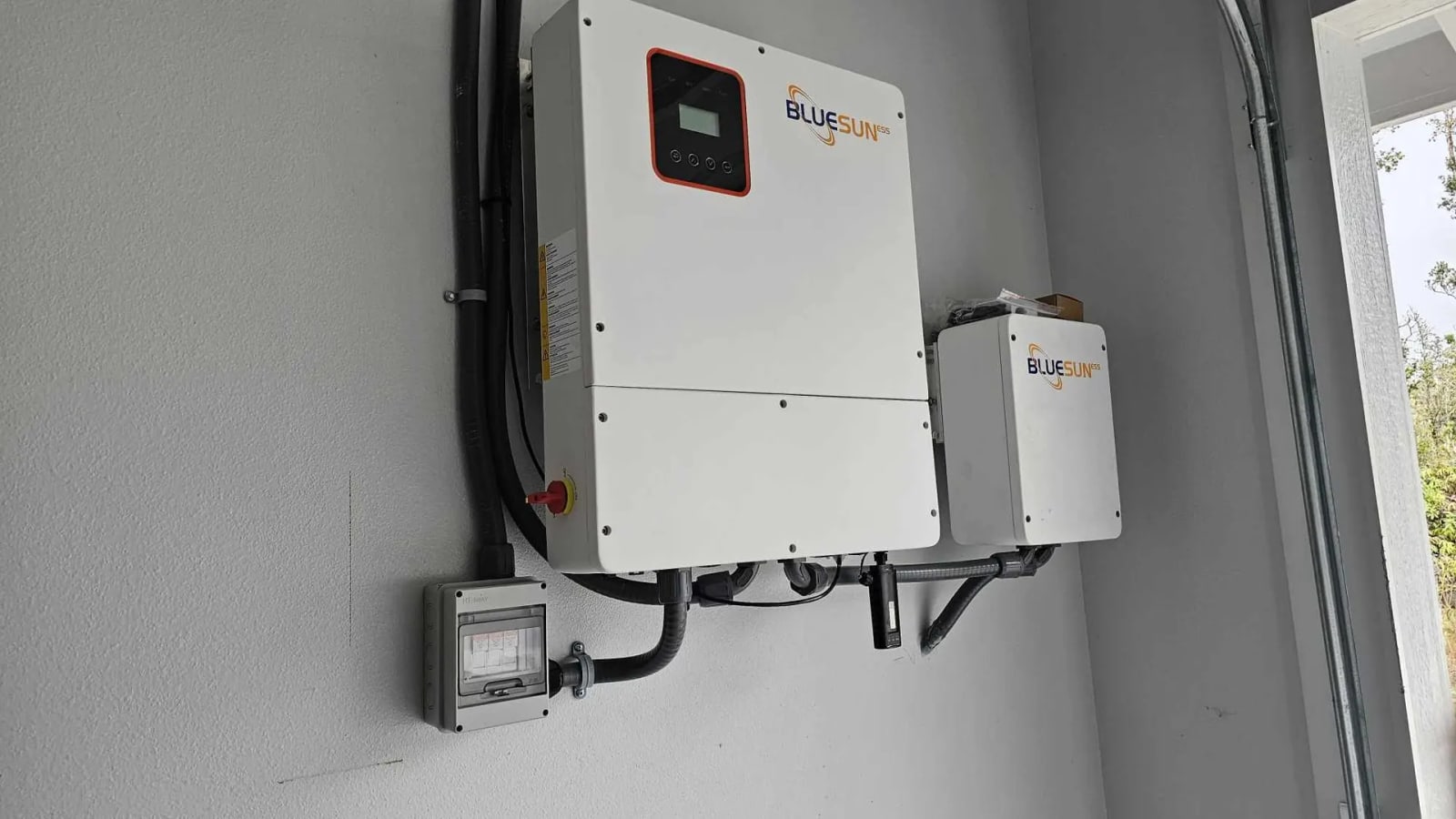
A hybrid system uses a hybrid inverter that can manage solar, utility power, a battery and selected backup circuits from one unit. The battery is optional at the start, which is why the same system can be sold with or without storage.
Without a battery, a hybrid system behaves like a grid-tied system: it reduces your bill and exports surplus, but it does not provide backup. Add a battery later and the inverter can charge it from solar or the grid, discharge it during expensive rate periods, and keep an essential-load panel energized during an outage.
- Battery-ready: the 8kW Complete, 10kW Premium and 12kW Whole Home ship with a hybrid inverter but no battery.
- Battery included: the 15kW Luxury ships with 27 kWh of lithium storage (two 13.5 kWh units).
- Whole-home backup requires a battery and inverter sized for your largest loads, plus a transfer arrangement installed by a licensed electrician. Most homes back up selected circuits instead.
- Utility approval is still required because the system is connected to the grid.
US naming: often marketed as grid-tied with storage or battery-ready. Battery-ready means the inverter has a battery interface and an approved battery list; it does not mean a battery is included.
Our hybrid kits: 8kW Complete, 10kW Premium, 12kW Whole Home and 15kW Luxury.
Off-grid solar system (with batteries)
An off-grid system has no utility connection. The array charges a battery bank, and an off-grid inverter/charger supplies a standard 120/240 V split-phase panel. A generator is often added as a winter backup, even when the solar array is sized correctly.
Off-grid systems are sized around your worst week of consumption, not your annual average. That usually means a larger array and a larger battery bank than a grid-tied home with the same loads. Heating, cooling, well pumps and electric vehicle charging can make the battery bank very large, so many off-grid buildings use propane or wood heat and keep high-draw loads off the solar system.
- No utility bill and no interconnection agreement.
- Battery bank required — the 10kW Off-Grid kit includes 13.5 kWh of lithium storage.
- Energy management matters. You cannot rely on the grid to cover a cloudy week.
- Permits still apply. Most jurisdictions require an electrical permit and inspection even when there is no utility service.
US naming: also called standalone or remote. An off-grid system has no utility interconnection because it has no utility connection.
Our off-grid kit: 10kW Off-Grid Solar + Battery. For a property that needs more storage or a larger array, start with the custom system.
What US installations require
The equipment is only half the project. These are the US rules that decide whether a system can be energized and inspected.
Utility interconnection — grid-tied and hybrid
Your utility will usually require an interconnection application, a single-line diagram, equipment datasheets and proof of insurance before approving the system. Do not energize the system before you receive permission to operate. The utility also decides whether exports are paid under net metering, net billing or another tariff, and whether your system size is capped.
Permits, inspection and code
A local electrical permit and inspection are standard for grid-tied and hybrid systems, and most jurisdictions require them for off-grid systems too. The authority having jurisdiction (AHJ) enforces the electrical code it has adopted, commonly the NEC. For solar work, the relevant sections include Article 690 (photovoltaic systems), Article 706 (energy storage systems) and the rapid-shutdown requirements in 690.12.
Listed equipment
Ask for the datasheet and a US listing mark. Common requirements are UL 1741 and IEEE 1547 for the inverter, UL 9540 for a packaged energy storage system, and UL 2703 for racking. Where adopted, NFPA 855 adds installation rules for storage. A CE mark or a foreign certificate is not a substitute for the listing your AHJ requires.
Service size and structural load
Residential service in the US is typically 120/240 V split-phase at 60 Hz; commercial buildings may be 208Y/120 V or 480Y/277 V three-phase. An older 100 A panel may need an upgrade before a large array or battery can be added. On a roof, the mounting design must handle the wind and snow loads for your area, and a structural review may be required before permits are issued.
Incentives and taxes
Federal, state, utility and local incentives change often, and their rules differ by system type, ownership and location. Confirm current eligibility with your tax professional, your utility and your state energy office before you rely on a rebate or credit in your payback calculation.
This page explains common US practice, not legal or tax advice. Your utility, AHJ and state rules control your project.
Which one fits your property?
- Choose grid-tied if you have a reliable utility, a reasonable export tariff and a limited budget. It is the lowest-cost way to cut a bill.
- Choose hybrid if you want bill savings now and the option of backup or time-of-use storage later. Buy the hybrid inverter at the start; replacing a grid-tied inverter later costs more.
- Choose off-grid if there is no utility service, the connection cost is prohibitive, or the property must operate independently. Plan for a larger battery bank and a backup generator.
If you are between sizes, run the savings calculator, then compare the ten kits side by side. A designer can confirm the service panel, roof structure and battery compatibility before you order.
Questions we get about this
Only if the inverter is hybrid or you add AC-coupled storage. A grid-tied string inverter cannot manage a battery directly. Replacing the inverter later usually costs more than choosing a hybrid inverter at the start.
No. Anti-islanding shuts the inverter off when utility power is lost so it cannot energize the lines. Backup requires a battery and an inverter with backup capability, plus a backup panel installed by a licensed electrician.
Usually not. Off-grid needs a battery bank and an array sized for the worst week, so equipment costs are higher. It can still be the right choice when the cost of extending utility service is greater than the cost of the system.
Yes, if they are connected to the grid. The utility interconnection application and permission to operate apply to hybrid systems just as they do to grid-tied systems. Off-grid systems have no interconnection agreement, but they still need local electrical permits and inspection.
Battery-ready means the inverter has a battery interface and is approved to work with listed batteries; it does not mean a battery is included. Confirm the battery model is on the inverter manufacturer’s approved list before ordering.